

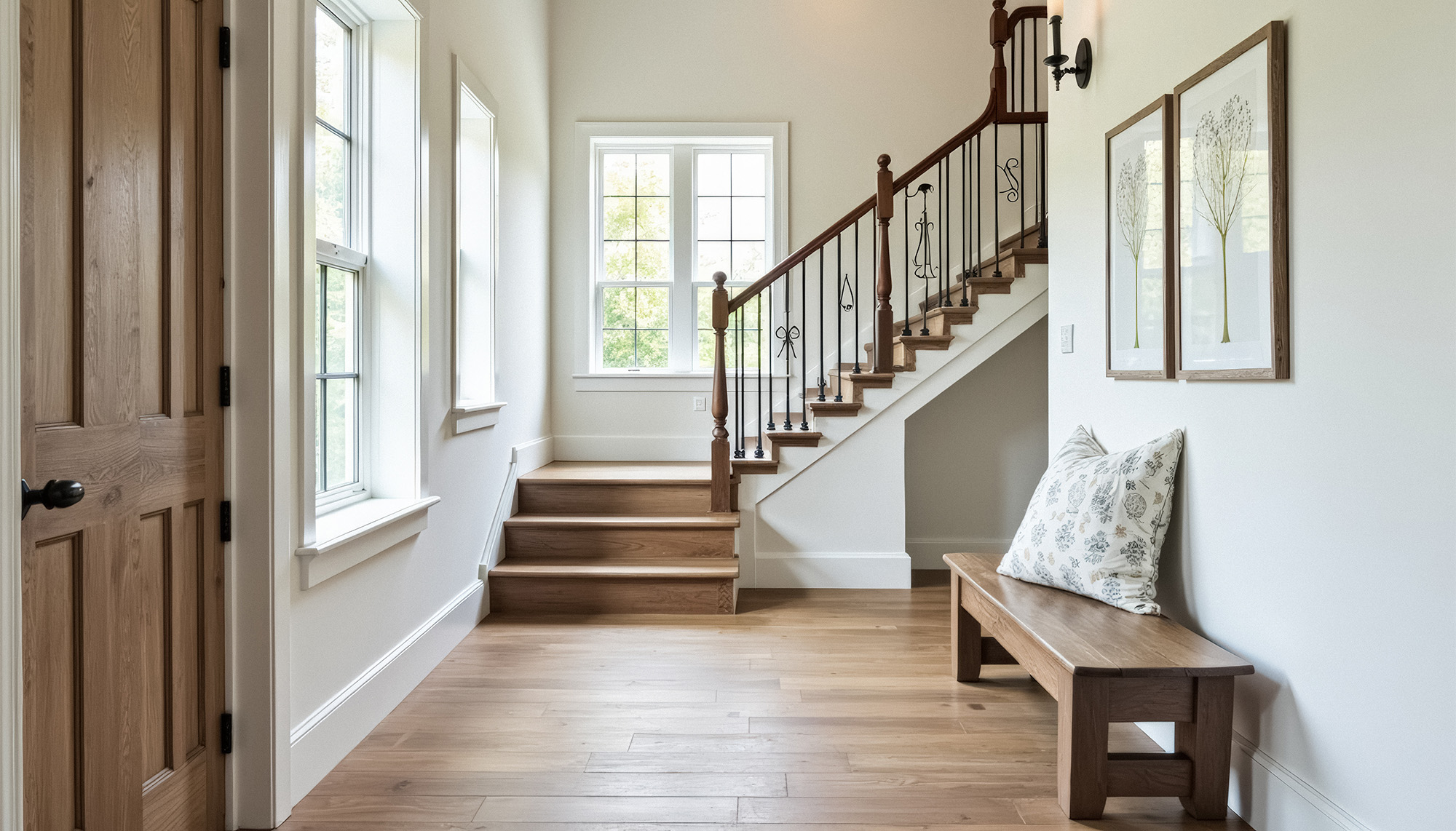
Living in a spacious two-story home gives your family room to spread out, entertain, and relax. However, when your second floor echoes every footstep, dropped item, or late-night trip down into your ground-floor living room or home office, your home quickly feels noisy. You might assume acoustic performance ratings and soundproofing only matter for coastal high-rise condominiums with strict HOA rules. In reality, sound control is just as essential when you live in a multi-story single-family home.
When you build or renovate a two-story home in South Florida, managing sound transmission between floors transforms your everyday living experience. Footfall noise, television audio, pet traffic, and morning routines should never disrupt someone resting downstairs. At Giant Carpet and Flooring, owners Moe and Ali work directly with you to select flooring systems that look beautiful, withstand South Florida humidity, and deliver quiet comfort. Understanding acoustic performance ratings helps you choose the ideal flooring and underlayment combinations for your upstairs living spaces.
Understanding Acoustic Ratings: IIC, STC, and Delta IIC
To choose quiet flooring for your second floor, you need to understand how sound ratings work. Three key metrics govern sound transmission in residential architecture: Impact Insulation Class (IIC), Sound Transmission Class (STC), and Delta IIC.
Impact Insulation Class (IIC) evaluates how well a floor-ceiling assembly blocks structure-borne impact noise. Impact noise occurs whenever an object strikes the floor directly, such as footsteps, running children, pet claws clicking across hard planks, or moving chairs. IIC ratings are expressed as whole numbers, with 50 serving as the standard building code minimum. In a busy family home, an IIC score of 50 often leaves you hearing noticeable thuds below. Selecting materials that achieve an assembly score of 55 to 60 or higher creates a noticeably calmer, more private environment.
Sound Transmission Class (STC) measures how well a floor-ceiling barrier blocks airborne noise. Airborne sounds travel through the air before vibrating the building structure, including voices, television audio, gaming consoles, and music systems. Like IIC, a higher STC rating indicates superior sound blocking. A baseline rating of 50 prevents normal speech from being understood downstairs, while ratings of 55 and above ensure high-volume sound remains subdued between levels.
Delta IIC is the most practical metric for you to evaluate when shopping for flooring and underlayment. While overall IIC measures the entire assembly, Delta IIC measures only the net acoustic improvement that the flooring and underlayment add on their own. An acoustic underlayment with a Delta IIC rating of 20 to 22 adds substantial sound-dampening power directly to your subfloor.
Multi-Story Construction in South Florida: Wood Joists vs. Concrete Slabs
The structural build of your home plays an enormous role in how sound behaves. In South Florida communities like Boca Raton, Boynton Beach, and Delray Beach, single-family homes feature specific construction techniques designed for our climate and coastal geography.
Most ground levels consist of a poured concrete slab on grade, which naturally absorbs low-frequency vibrations and blocks sound transmission. In contrast, the second floor of a single-family home across Lake Worth, West Palm Beach, Wellington, and Parkland is typically built with wood floor joists or engineered trusses topped with plywood or oriented strand board subflooring.
Wood frame assemblies have significantly less physical mass than concrete slabs. Without heavy concrete to absorb energy, a standard wood subfloor can act like a drumhead. When you step on a hard surface upstairs, impact vibrations travel through the floor covering, into the wood subfloor, across the hollow joist cavities, and down through the drywall ceiling below. That is why choosing the right acoustic underlayment and flooring surface is essential for upstairs bedrooms, playrooms, and hallways.
Why Second-Floor Soundproofing Needs a Tailored Approach
When you live in a single-family home, you do not face HOA fines for noise, but your family experiences the consequences daily. Addressing acoustic performance on a wood subfloor requires materials that decouple vibrations before they transfer into the framing. Whether you are building new construction in Parkland or remodeling an established home in Boca Raton, planning your acoustic barrier from the subfloor up ensures peaceful living throughout your home.
Top Flooring Solutions for Upstairs Acoustics
When planning your upstairs flooring renovation, you never have to sacrifice personal style to achieve acoustic comfort. We guide you through premium materials that balance beauty, durability, and acoustic control.
Carpet and Carpet Tile: The Gold Standard for Silence
If your primary goal is eliminating impact noise in upstairs bedrooms, nursery spaces, and staircases, carpet remains the undisputed leader. Carpet fibers naturally absorb impact energy before it ever reaches the subfloor. A plush cut pile or textured loop carpet paired with a high-density cushion can push your overall assembly IIC rating well into the 65 to 70 range.
At Giant Carpet and Flooring, we offer exceptional residential carpets crafted from premium nylon, polyester, and Triexta fibers from leading brands like Mohawk, Shaw Floors, DreamWeaver, Masland, and Engineered Floors. Triexta and nylon offer stain resistance and resilient bounce-back, making them ideal for active households with kids and pets. For versatile spaces like home offices or bonus rooms, carpet tile provides great acoustic dampening alongside quick spot-replacement convenience.
Luxury Vinyl Plank (LVP) and Waterproof Flooring
If you prefer the clean look of hardwood upstairs, luxury vinyl plank and 100% waterproof flooring are outstanding options. High-quality LVP from trusted manufacturers like COREtec, Mannington, MSI, and Tarkett features attached acoustic backings, typically made of high-density IXPE or EVA foam.
These attached pads help mute footfall noise and create a softer feel underfoot. For even greater acoustic isolation on wood subfloors, we install a dedicated sound-rated acoustic underlayment beneath your floating vinyl planks to absorb impact sound and isolate vibrations.
Engineered Hardwood and Premium Laminate
Engineered hardwood is specially crafted with cross-ply layers that resist South Florida humidity while giving you genuine wood beauty. When installed on second-floor living spaces, floating engineered wood floors perform best when paired with a high-grade acoustic underlayment.
High-performance laminate flooring from brands like Quick-Step also provides exceptional scratch resistance with realistic wood grain textures. Pairing engineered wood or laminate with specialized acoustic underlayment, such as dense recycled rubber, acoustic foam, or natural cork, significantly dampens foot traffic noise and hollow clicking sounds.
Area Rugs for Secondary Sound Absorption
If you have hard surfaces in second-floor hallways, lofts, or open master suites, adding decorative area rugs softens room acoustics. Area rugs trap airborne sound waves, reduce room echo, and soften footsteps in high-traffic paths.
How Our 4-Step Installation Protects Your Acoustics
Proper installation is just as important as the materials you select. If an installer cuts corners, sound can easily bridge around materials and travel through the structure. At Giant Carpet and Flooring, our licensed installation team follows a disciplined 4-step process on every project:
Step 1: Measurement and Preparation. We inspect your subfloor, check for loose decking or squeaks, address uneven areas that cause hollow spots, and test for moisture pressure.
Step 2: Material Preparation. We acclimate all materials according to manufacturer standards so your floors perform flawlessly in South Florida humidity.
Step 3: Professional Installation. Our licensed installers lay your acoustic underlayment seamlessly and maintain precise perimeter expansion gaps along walls, preventing sound vibrations from bridging into baseboards and drywall.
Step 4: Final Walkthrough. Owners Moe and Ali believe in complete accountability. We walk the finished project with you to ensure every room looks beautiful, feels solid, and delivers quiet performance.
Upgrade Your Multi-Story Home with Giant Carpet and Flooring
You do not have to live with booming footsteps and echoing floors in your two-story home. Whether you need plush carpet for your bedrooms, waterproof luxury vinyl plank for your hallway, or stunning engineered hardwood for your master suite, we have the local expertise and quality products to make your home quiet and serene.
Visit either of our showrooms in Boca Raton or Boynton Beach, book our Mobile Showroom to shop comfortably from home, or contact us today for your free in-home flooring estimate. We proudly serve you across Boca Raton, Boynton Beach, Delray Beach, Lake Worth, West Palm Beach, Wellington, and Parkland, FL, as well as surrounding communities throughout Palm Beach and Broward Counties, including Deerfield Beach, Highland Beach, Pompano Beach, North Palm Beach, and Coral Springs.


